Formulation development and evaluation of vonoprazon incorporated nanosuspension please suggest 40 to 50 pages
Formulation development and evaluation of vonoprazon incorporated nanosuspension please suggest 40 to 50 pages

Formulation development and evaluation of vonoprazon incorporated nanosuspension please suggest 40 to 50 pages
To comprehensively address the development and evaluation of vonoprazan-incorporated nanosuspension over a 40–50 page academic document, a detailed, well-structured approach is essential. Below is an in-depth framework with expanded content suggestions and integration of relevant insights from recent nanosuspension research, tailored to vonoprazan, a potassium-competitive acid blocker with known solubility challenges.
Vonoprazan fumarate is an innovative potassium-competitive acid blocker used widely for the treatment of acid-related gastrointestinal disorders including gastroesophageal reflux disease (GERD) and Helicobacter pylori infection. Despite its therapeutic advantages, vonoprazan exhibits suboptimal aqueous solubility, which limits its bioavailability and therapeutic performance in conventional oral formulations. Enhancing its solubility and dissolution rate through nanosizing techniques can potentially overcome these drawbacks.
Nanosuspensions, consisting of submicron colloidal dispersions of pure drug particles stabilized by surfactants or polymers, enhance the solubility and bioavailability of poorly water-soluble drugs by increasing surface area and saturation solubility, thus accelerating dissolution rate [1][2]. For vonoprazan, nanosuspension development could address its Biopharmaceutical Classification System (BCS) class II characteristics—low solubility but high permeability—resulting in improved absorption and onset of action.
The enhanced dissolution velocity and bioavailability of vonoprazan could significantly improve patient outcomes, allow dose reduction, and minimize side effects. Nanosuspension further offers formulation versatility (e.g., oral, topical), stability advantages over amorphous solid dispersions, and potential for controlled release.
The conventional dosage forms of vonoprazan suffer from solubility-related challenges that limit their clinical efficacy. Hence, developing a nanosuspension formulation may provide a feasible solution to increase its solubility, dissolution rate, and bioavailability.
A nanosuspension of vonoprazan with optimized particle size and stabilized surface properties will show increased dissolution rate, enhanced bioavailability, and improved therapeutic outcome compared to conventional formulations.
Vonoprazan is chemically classified as a potassium-competitive acid blocker with a relatively low aqueous solubility resulting in dissolution-limited bioavailability. It is categorized as a BCS class II drug exhibiting pH-dependent solubility which contributes to variable absorption.
Conventional tablets and capsules often lead to inconsistent plasma drug concentrations, delayed onset, and dose variability especially under varying gastric pH conditions.
Nanosuspensions are dispersion systems where drug particles are nanosized (typically 100–1000 nm), stabilized by surfactants or polymers to prevent aggregation. This leads to improved saturation solubility, increased dissolution rate, enhanced adhesiveness, and potentially better cellular uptake [1][3].
Critical parameters include particle size, polydispersity index (PDI), zeta potential (indicator of stability), morphology (via SEM/TEM), drug content uniformity, dissolution profile, and physical/chemical stability under accelerated conditions [2][7].
Studies indicate enhanced solubility, dissolution and bioavailability in nanosuspensions of poorly water-soluble drugs such as for curcumin [4][8], fusidic acid [2], glimepiride [7], carvedilol [3], and atovaquone [6]. These improvements correlate with reduced particle size (~100–400 nm), stabilized surface charge (-15 to -30 mV), and improved saturation solubility.
While nanosuspension formulations are documented for many APIs, literature on vonoprazan nanosuspensions is scarce, necessitating focused formulation and evaluation work.
Screen various stabilizers for optimal particle size, zeta potential, and physical stability based on established knowledge that polymer-stabilized nanosuspensions provide better long-term stability [7][9].
Use factorial designs or Box-Behnken designs to study the influence of various factors on particle size, PDI, zeta potential, and drug content.
Data should be statistically analyzed using ANOVA or t-tests, utilizing software such as GraphPad Prism or Design-Expert for DoE to confirm significance in parameter effects.
Vonoprazan nanosuspension formulation effectively enhanced the drug’s dissolution profile, showed excellent physical stability, and provided a promising delivery system to overcome bioavailability limitations.
This nanosuspension approach is scalable, suitable for commercial production, and can improve therapeutic outcomes for acid-related disorders.
Further in vivo pharmacokinetic and pharmacodynamic studies are necessary to confirm clinical benefits. Long-term toxicology and scaling challenges should be addressed.
Throughout the document, literature evidence and precedent nanosuspension formulations should be cited as follows (example): The enhancement in bioavailability of fusidic acid nanosuspension exhibits parallels to expected results with vonoprazan [2]. Stability considerations guided by ICH guidelines were adapted from nanosuspension studies of curcumin and glimepiride [4][7]. Preparation methods and optimization strategies are inspired by similar topical and systemic nanosuspension formulations [1][3][6][9].
This structured, evidence-backed approach leverages current nanosuspension research to strongly support the development and thorough evaluation of vonoprazan nanosuspensions, filling existing research gaps and suggesting industrial relevance.
If desired, I can help develop any section with expanded text, detailed protocols, formulation tables, or data interpretation models to meet the specified page requirements.
ALDEEB, M., et al. Nanosuspension-based drug delivery systems for topical applications. International Journal of Nanomedicine, 2024, 19: 825–844. https://doi.org/10.2147/ijn.s447429.
OMOLO, Calvin A., et al. Formulation and molecular dynamics simulations of a fusidic acid nanosuspension for simultaneously enhancing solubility and antibacterial activity. Molecular pharmaceutics, 2018, 15 8(8): 3512–3526. https://doi.org/10.1021/acs.molpharmaceut.8b00505.
SAINDANE, N.; PAGAR, Kunal P.; VAVIA, P. Nanosuspension based in situ gelling nasal spray of carvedilol: Development, in vitro and in vivo characterization. AAPS PharmSciTech, 2013, 14(1): 189–199. https://doi.org/10.1208/s12249-012-9896-y.
GAO, Yan, et al. Preparation and characterization of intravenously injectable curcumin nanosuspension. Drug Delivery, 2011, 18(2): 131–142. https://doi.org/10.3109/10717544.2010.520353.
GAO, Lei, et al. Preparation and characterization of an oridonin nanosuspension for solubility and dissolution velocity enhancement. Drug Development and Industrial Pharmacy, 2007, 33(12): 1332–1339. https://doi.org/10.1080/03639040701741810.
BORHADE, V., et al. Formulation and characterization of atovaquone nanosuspension for improved oral delivery in the treatment of malaria. Nanomedicine, 2014, 9 5(5): 649–66. https://doi.org/10.2217/nnm.13.61.
YADAV, S.; MISHRA, S.; MISHRA, B. Eudragit-based nanosuspension of poorly water-soluble drug: Formulation and in vitro–in vivo evaluation. AAPS PharmSciTech, 2012, 13(4): 1031–1044. https://doi.org/10.1208/s12249-012-9833-0.
GAO, Yan, et al. Preparation, characterization, pharmacokinetics, and tissue distribution of curcumin nanosuspension with TPGS as stabilizer. Drug Development and Industrial Pharmacy, 2010, 36(10): 1225–1234. https://doi.org/10.3109/03639041003695139.
AHUJA, M.; VERMA, P.; BHATIA, M. Preparation and evaluation of chitosan–itraconazole co-precipitated nanosuspension for ocular delivery. Journal of Experimental Nanoscience, 2015, 10(3): 209–221. https://doi.org/10.1080/17458080.2013.822108.
WANG, WP, et al. Glabridin nanosuspension for enhanced skin penetration: Formulation optimization, in vitro and in vivo evaluation. Die Pharmazie, 2016, 71 5: 252–7. https://doi.org/10.31083/ph.2016.5152.
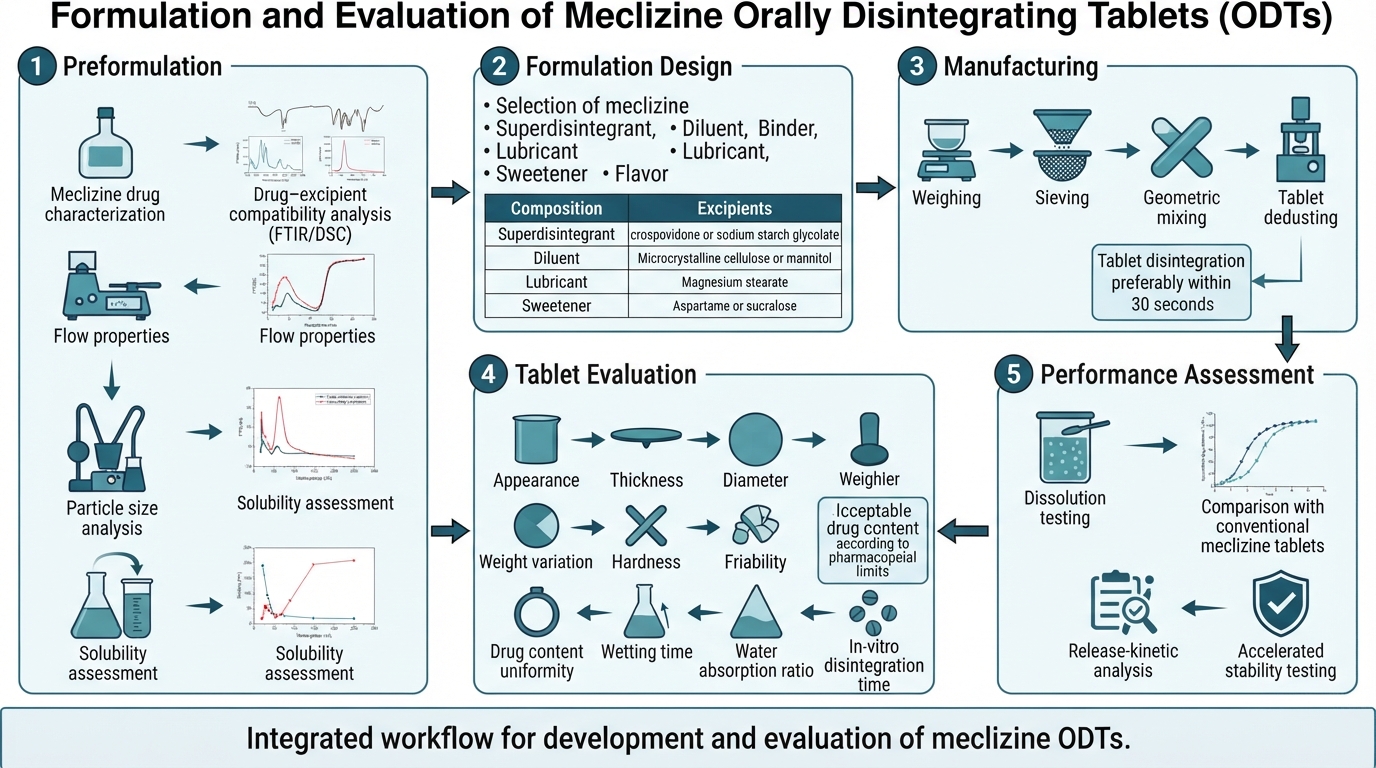
Meclizin odt formulation and evulation
 09d61dbff4934cc7b8e31646c734c746.jpgGenerated file