


Starting a research search often leads to more results than expected. Many papers seem relevant at first glance. Their titles look similar, their abstracts mention familiar concepts, and it can be difficult to decide which paper deserves your attention first.
At this stage, trying to turn search results directly into manuscript-ready paragraphs can slow you down. You may end up reading too broadly, taking scattered notes, and reorganizing the same papers later.
A better first step is to build a literature map.
A literature map is not a finished section of your paper. It is a working view of your paper candidates. It helps you see which papers are central to your research question, which ones are useful for methods, which ones provide background, and which ones should be excluded.
Some papers will directly support your research question. Some will help you design your study or compare methods. Others may only provide context. Some papers may look relevant from the title but turn out to be outside your scope. Making these distinctions early helps you move from a long search result list to a clearer reading plan.
tlooto can support this early stage of research by helping you collect paper candidates and organize the criteria you need to review. However, tlooto should not be treated as a tool that makes the final research judgment for you. The decision about which papers to read, cite, or exclude should remain with the researcher.
Why a Literature Map Helps
Many researchers begin by trying to find as many relevant papers as possible. But in early-stage research, the number of papers is not the most important thing. What matters is understanding what role each paper plays in your own research.
Even when papers address the same broad topic, they may differ in their research subjects, methods, data, theoretical perspective, or limitations. For example, if you are studying the educational impact of generative AI, one paper may focus on undergraduate students’ usage experiences, another may measure writing performance, and another may analyze instructors’ evaluation criteria.
If these papers are kept in one long list, they may all look equally “relevant.” But once you organize them into a literature map, their roles become clearer. You can separate papers that provide core evidence from papers that are useful for methodology, background, or exclusion.
Build a Literature Map in tlooto
A literature map does not need to be perfect. In the beginning, it is simply a draft that helps you prepare for the next search, the next meeting, or the next round of reading.
The goal is to answer three practical questions:
What should I read first?
Why should I keep this paper?
What do I still need to verify?
Before searching further, reduce your research interest to one clear sentence. Instead of starting with a broad phrase such as “AI and education,” try to write a more specific question such as:
How does undergraduate students’ use of generative AI affect the process of academic writing assignments?
A sentence like this gives you a clearer basis for sorting papers. It includes the target group, technology, context, and possible outcome. Once you have this sentence, you can collect paper candidates and organize them using four criteria: topic, method, data, and limitations.
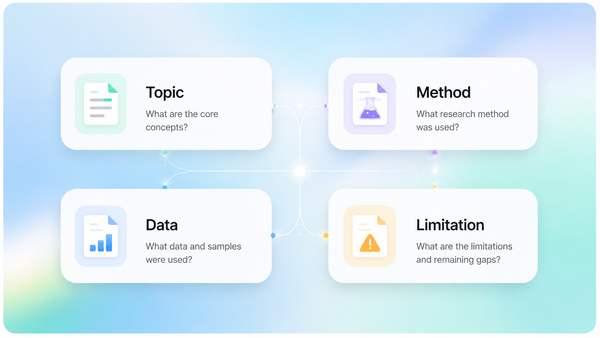
1. Topic
First, check what core concept each paper is actually addressing. A paper should be kept as a strong candidate if its main concept is directly connected to your research question.
For example, if your research question is about undergraduate students’ use of generative AI in academic writing, a paper about AI in education in general may be useful as background. But a paper about AI writing tools, assignment writing, learning experience, or writing self-efficacy may be more directly relevant.
At this stage, do not only look at whether the paper contains the same keyword. Ask whether the paper is really dealing with the same problem you are trying to study.
2. Method
Next, look at how the paper conducted the research. A survey, experiment, interview study, log analysis, case study, or systematic review will each produce a different kind of evidence.
If you are planning a survey study, papers with similar survey items or variable structures may be especially useful. If you are planning an experiment, papers with clear experimental conditions, control groups, and evaluation criteria may be more important.
This is why method should be separated from topic. A paper can be topically relevant but methodologically weak for your purpose. Another paper may not match your topic perfectly but may offer a useful research design.
3. Data
Then, check the data. Who was studied? How many participants were included? What period was covered? What country, institution, or platform provided the data?
Data context matters because research findings do not always transfer directly from one setting to another. A study of students in one country may not fully apply to students in another system. A short-term experiment should not be treated as evidence for long-term learning outcomes.
For each paper, note whether the data is comparable to your own research setting. If the data context is too different, the paper may still be useful, but it should be used carefully.
4. Limitations
Finally, look at what the authors identify as limitations. Limitations are not just weaknesses. They often point to where your own research may contribute.
A good research gap is not simply a place where there are fewer papers. It often appears where existing studies have not fully explained differences in subjects, methods, data, context, or theory.
For this reason, the limitations section can be one of the most useful parts of a paper. It helps you see what has already been studied and what still needs to be examined.
A Question You Can Try in tlooto
You can use a prompt like this to organize your first set of paper candidates:
Find recent papers from the past five years related to [your research topic]. Classify each paper by topic, method, data, and limitations. Recommend the first 10 papers I should read, and indicate whether each paper is best used as core evidence, a methodological reference, background context, or a possible research gap.
The important point is not to copy the result directly into your paper. The response should be treated as a starting point for review. After receiving paper candidates, you still need to check the abstracts, open the original sources when possible, and record why each paper was kept or excluded.
Sort Papers by Their Role
When building a literature map, do not treat every paper equally. Start by assigning each paper one of four roles.
Core Evidence
These are papers that directly answer your research question or are closest to your topic. They are likely to become central references in your paper.
For example, if you are studying the relationship between AI tool use and writing performance, you should check whether the paper’s research subject, measurement method, and findings are close enough to your own research question.
Methodological Reference
These are papers that help you design your study. They may provide useful examples of survey items, experimental conditions, interview questions, coding schemes, or log data analysis methods.
For these papers, the conclusion may be less important than the procedure. Read the method section carefully and note what can be adapted to your own study.
Background Context
These papers help explain key concepts, field-level trends, or the broader research environment. Review papers, conceptual papers, and field overviews often belong here.
However, background papers should not be used as direct evidence for a narrow research claim. They are useful for framing the topic, but their role should not be overstated.
Excluded Candidates
Some papers may have similar titles or keywords but turn out to be outside your scope. They may focus on a different population, use a method that does not match your question, or rely on data that cannot be compared with your setting.
It is still useful to record why these papers were excluded. Exclusion notes help you explain your search process later to your advisor, collaborators, or reviewers.
A Simple Template You Can Use
You can organize your literature map with the following fields:
Paper title/Role/Topic/Method/Data/Limitations/Original source checked?/Next action
For example:
Paper A
Role: Core evidence
Topic: Directly related to my research question
Method: Survey
Data: Undergraduate student sample
Limitation: Short-term self-reported data
Original source checked: Abstract checked
Next action: Read full text
Paper B
Role: Methodological reference
Topic: Similar research context
Method: Experiment
Data: Assignment scores
Limitation: Small sample size
Original source checked: Full text checked
Next action: Take notes on the method section
Paper C
Role: Background context
Topic: Conceptual overview
Method: Review
Data: Existing literature
Limitation: No original empirical data
Original source checked: Abstract checked
Next action: Use only for background explanation
This kind of table is simple, but it gives structure to your reading. It also prevents you from treating every search result as equally important.
Common Mistakes to Avoid
The first mistake is copying an AI-generated paper list directly into your writing. A summary generated by an AI tool is not a final research paragraph. It is something to review. Any claim that appears in your paper should be checked against the original source.
The second mistake is assuming that a small number of papers automatically means there is a research gap. A research gap is not just an empty space in the search results. It is a question, context, method, dataset, or theoretical issue that existing research has not fully addressed.
The third mistake is failing to record excluded papers. In research, what you leave out can be just as important as what you keep. When you record exclusion reasons, your search process becomes easier to explain and defend.
Conclusion
The purpose of a literature map is not to collect as many papers as possible. It is to decide which papers to read first, which evidence needs further checking, and which papers should be set aside.
When using tlooto, treat the output as a way to organize candidates and review criteria, not as a finished answer. Start by narrowing your research interest into one clear sentence. Then collect paper candidates and sort them by topic, method, data, and limitations.
Even this simple process can make the structure of prior research much easier to see. Once your literature map is clear, your reading becomes more focused, and your next research steps become easier to decide.
Try Building a Literature Map in tlooto
If you already have a research topic, start by entering it into tlooto and asking for paper candidates by role. Then review the results using the four criteria in this guide: topic, method, data, and limitations. This will help you move from a long list of search results to a clear, manageable reading plan.