

It usually goes like this. The draft is due in two days, the chatbot has produced a tidy paragraph with four references, and the third one looks perfect. Real-sounding authors. A journal in the right field. A 2021 publication year. Forty minutes of searching later, you accept that the paper was never written.
This is not a rare glitch. When researchers asked ChatGPT to write short literature reviews on 42 topics, 55% of the GPT-3.5 citations and 18% of the GPT-4 citations were fabricated, and many of the real ones still had substantive errors [1]. In the OpenScholar evaluation, GPT-4o fabricated 78 to 90% of the scientific citations it produced [2].
The cost is not only embarrassment. A fabricated reference in a thesis chapter or a submitted manuscript is a research integrity problem, and reviewers and supervisors increasingly check.
Why chatbots invent references
A general chatbot writes from what its model remembers. It knows what a citation in your field usually looks like: which surnames appear, which journals, which years. When it cannot recall a real source, it can still produce something that has the right shape. The result reads fine, which is exactly why it slips through.
The five-minute reference check
Before any AI-assisted reference goes into your manuscript, run these checks. They take a few minutes per paragraph and they catch almost everything.
- Resolve the DOI. Paste it after https://doi.org/. If there is no DOI, or it lands on a different paper, stop.
- Match three fields. First author, year and journal must all agree with the landing page. Fabricated references often get two of three right.
- Read the abstract against the claim. A real paper can still be cited for something it never said. Check that the abstract supports the exact sentence that cites it.
- Search the title in quotes. A real paper shows up in a scholarly index. A fabricated one returns nothing, or a near-miss with a different author list.
- Keep the PDF or the landing page. If you cannot open it, you cannot defend it in a viva or a peer review.
Better: never let an unretrieved paper into the draft
Checking after the fact works, but it is slow. The more reliable fix is to change the order of operations: search first, screen the results, and only then write, citing only papers that were actually retrieved.
That is how tlooto is built. When you ask a research question, tlooto plans a set of searches, retrieves papers from a scholarly index with authors, venue, year, DOI and abstract, screens them against your criteria, and writes the report from the papers that passed. Every sentence carries a numbered citation, and the reference list is generated from the same records as the body, so the two always agree.
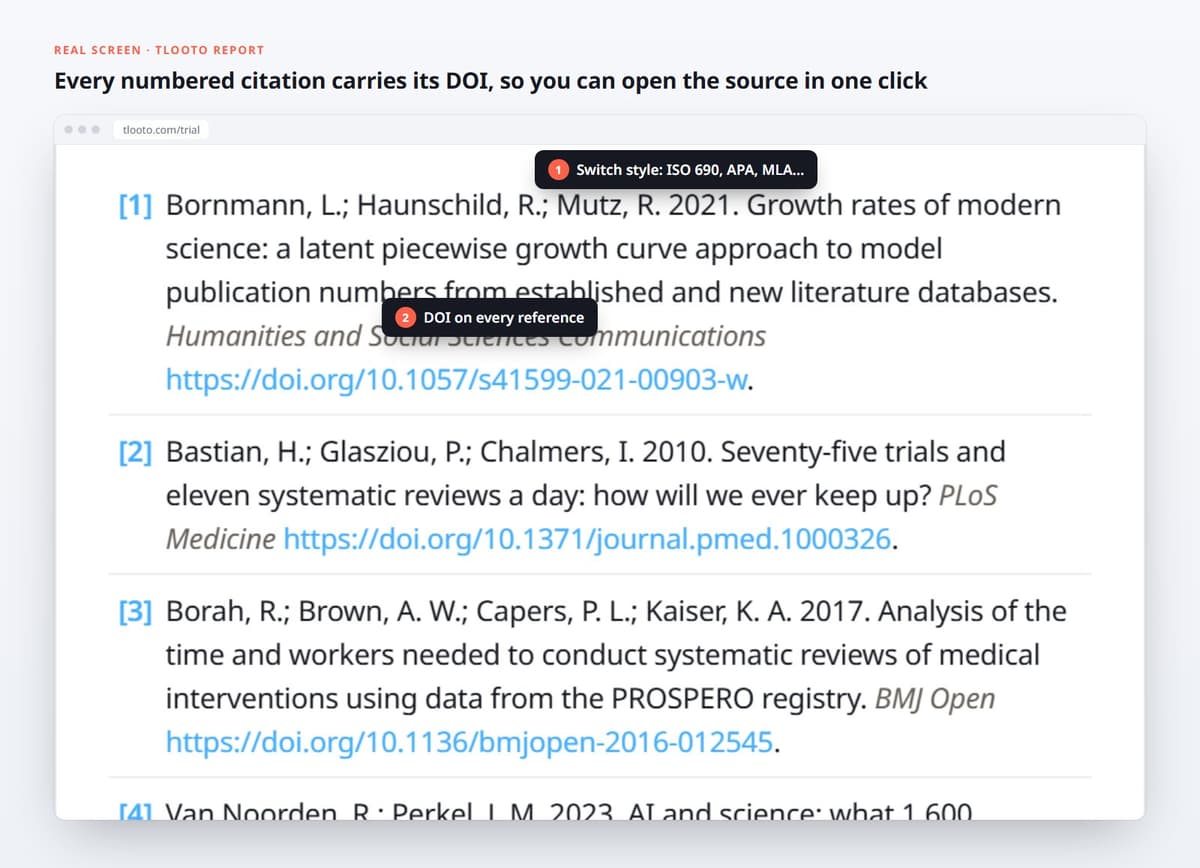
The reference list in a tlooto report. Each entry links to its DOI, and the style can be switched without rewriting anything.
You still read the papers. tlooto does not make the research judgment for you, and it should not. But you start from a list of sources that exist, instead of a paragraph you have to take apart.
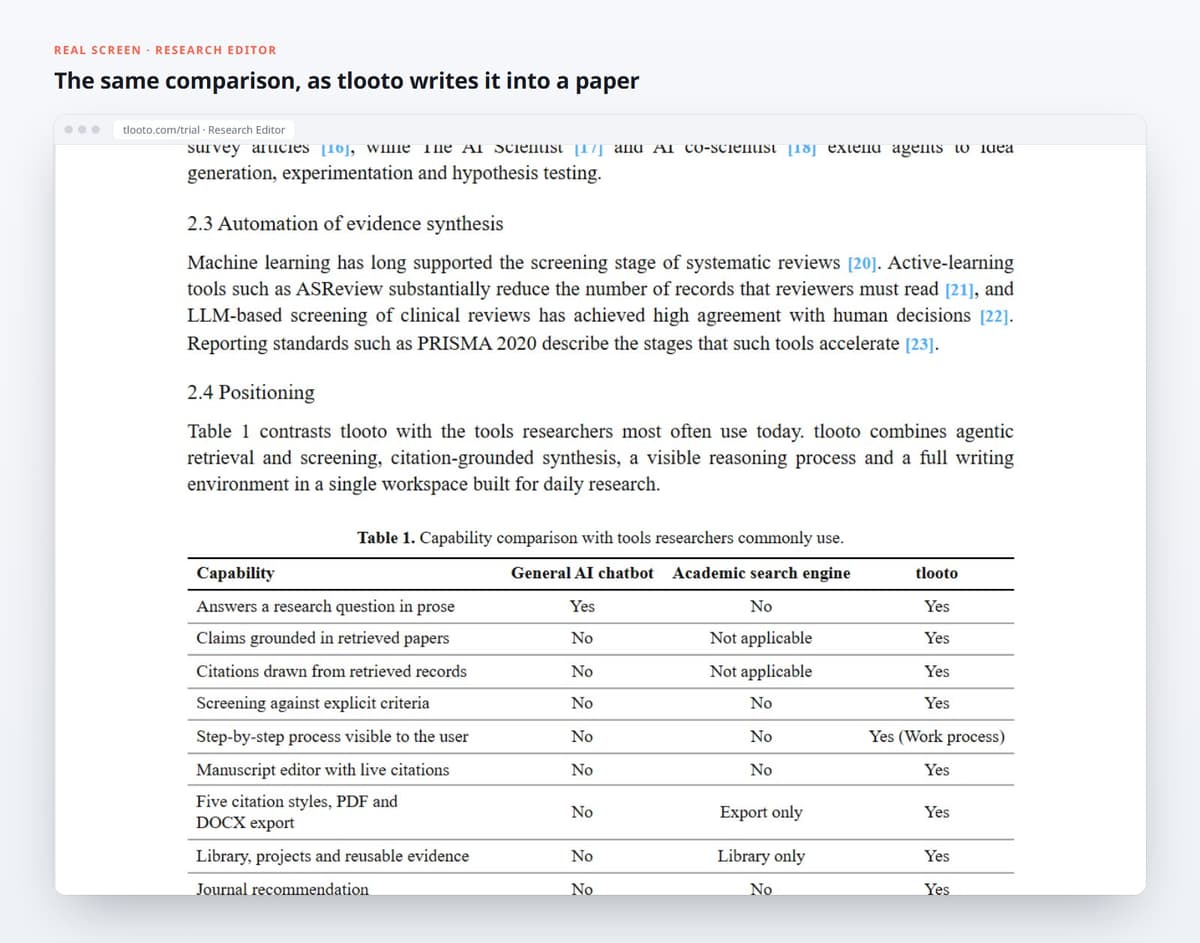
See a cited tlooto report, no sign-up needed →
A quick rule for your lab or class
If a reference cannot be opened, it does not go in. Share that rule with anyone who is using AI for writing. It is simple enough to remember at 2 a.m., which is when most of these mistakes happen.
References
[1] Walters, W. H., & Wilder, E. I. (2023). Fabrication and errors in the bibliographic citations generated by ChatGPT. Scientific Reports, 13. https://doi.org/10.1038/s41598-023-41032-5
[2] Asai, A., et al. (2024). OpenScholar: Synthesizing scientific literature with retrieval-augmented LMs. arXiv. https://arxiv.org/abs/2411.14199