

The example analysis on the tlooto AI Detector page, stepping through sentences one by one.
Picture the message: I wrote every sentence of this myself. The detector says 70% AI. My professor wants to talk.
It is a horrible position to be in, and it is more common than it should be. In a Stanford study, seven widely used GPT detectors misclassified more than half of TOEFL essays written by non-native English speakers as AI-generated, while essays by native speakers were judged far more accurately [1]. Careful, formal, well-edited English, the kind academic writing asks for, is exactly what many detectors find suspicious.
What a detector is actually measuring
Detectors do not know who wrote a text. They estimate how predictable it is. Sentences built from common phrasing, balanced structure and general claims look statistically similar to model output. So a sentence like These findings highlight the importance of adopting a holistic approach gets flagged whether a person or a model wrote it, because it says very little in a very familiar way.
That is also why a single overall percentage is weak evidence. It hides which sentences drove the score and why.
What to do with a flag
- Look at sentences, not the score. Find which sentences were flagged. In most human-written drafts it is a handful of generic transitions and summary lines.
- Replace generality with specifics. Put your numbers, your sample, your comparison in the sentence. Students who used their phones more than seven hours a day had a first-semester GPA 0.21 points lower reads as a person who ran the analysis.
- Keep your process evidence. Drafts, version history, notes and data files are the strongest proof of authorship you have. Save them as you go.
- Follow your institution’s AI policy and disclose tool use where it is required. A detector result should start a conversation, not end one.
Sentence-level analysis in tlooto
tlooto’s AI Detector shows its evidence sentence by sentence. Each sentence is marked as an AI-writing signal, inconclusive, or clear, and you can click any highlighted sentence to see why it was flagged. From there you can rewrite it yourself or use the Humanizer to suggest a revision, then check again.
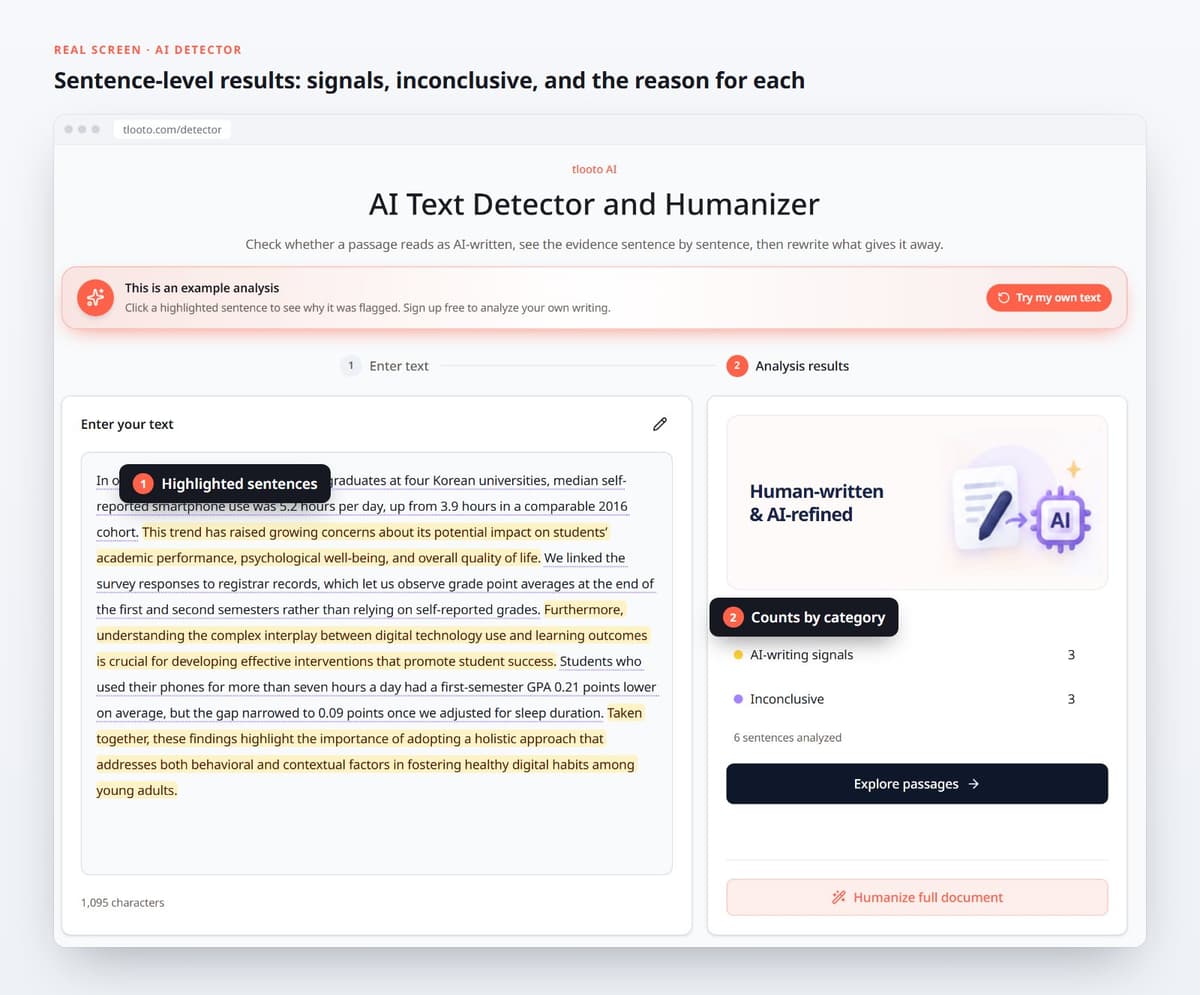
In the example on the detector page, the flagged sentences are the generic ones: the trend statement, the Furthermore line and the closing summary. The sentences with the actual findings pass. That pattern is the most useful thing a detector can tell you, because it points at the sentences that were weakest anyway.
Run the sentence-level example →
References
[1] Liang, W., Yuksekgonul, M., Mao, Y., Wu, E., & Zou, J. (2023). GPT detectors are biased against non-native English writers. Patterns, 4(7). https://doi.org/10.1016/j.patter.2023.100779