

Ask researchers what takes longest in a literature review and most say writing it up. Look at where the hours actually go and writing is usually the smallest slice.
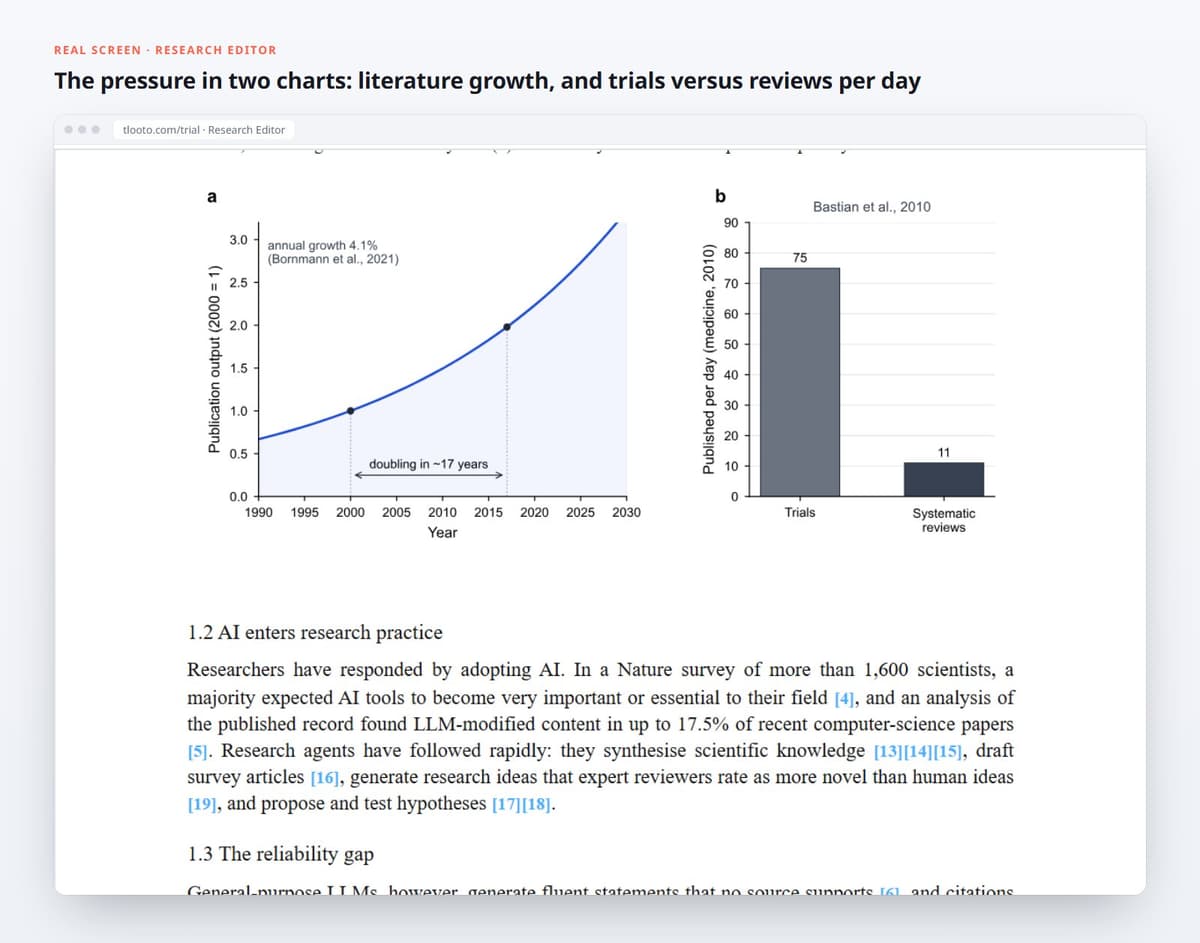
The numbers are sobering. Systematic reviews registered in PROSPERO took a mean of 67.3 weeks from registration to publication [1]. Scientific output grows by about 4.1% a year, doubling roughly every 17 years [2]. And back in 2010, medicine was already publishing around 75 trials and 11 systematic reviews a day [3].
The usual breakdown
Every project is different, but when researchers describe a typical narrative review, the time falls into the same buckets:
- Searching and re-searching. Refining queries, trying synonyms, discovering a key term late and running everything again.
- Screening. Reading hundreds of titles and abstracts to find the few dozen that matter, then second-guessing the borderline ones.
- Re-finding. Looking for the paper you read three weeks ago that said the exact thing you now need to cite.
- Reference housekeeping. Formatting, deduplicating, fixing numbering after edits.
- Actually reading and thinking. The part that produces the insight, and usually the part that gets squeezed.
Only the last bucket requires you. The first four are mechanical, and they are where most of the calendar goes.
What is worth handing to a tool
The honest answer is: the mechanical parts, with the reasoning visible. Machine learning has been used to speed up evidence synthesis for years, especially screening [4]. What changed recently is that a single workspace can now plan the searches, screen against your criteria, and write a cited first pass, while showing every step.
That is the design goal of tlooto. Searching, screening, citing and formatting happen in one place, and the Work process panel shows what was searched and why each paper was kept. The Library keeps what you found. The time you get back goes into the part only you can do: reading closely and deciding what the evidence means.
A small experiment
For your next review, keep a rough log for one week: how many hours went to searching, screening, re-finding, formatting and reading. Most people are surprised by the first three. That number is the case for changing how you work.
See how tlooto structures a review →
References
[1] Borah, R., Brown, A. W., Capers, P. L., & Kaiser, K. A. (2017). Analysis of the time and workers needed to conduct systematic reviews of medical interventions. BMJ Open, 7(2). https://doi.org/10.1136/bmjopen-2016-012545
[2] Bornmann, L., Haunschild, R., & Mutz, R. (2021). Growth rates of modern science. Humanities and Social Sciences Communications, 8. https://doi.org/10.1057/s41599-021-00903-w
[3] Bastian, H., Glasziou, P., & Chalmers, I. (2010). Seventy-five trials and eleven systematic reviews a day. PLoS Medicine, 7(9). https://doi.org/10.1371/journal.pmed.1000326
[4] Marshall, I. J., & Wallace, B. C. (2019). Toward systematic review automation: a practical guide to using machine learning tools in research synthesis. Systematic Reviews, 8. https://doi.org/10.1186/s13643-019-1074-9