

Four hundred abstracts is a normal number for a modest review. At a minute each, that is a full working day, and nobody screens well for eight hours straight. By abstract 250 the decisions start to drift, and by 350 you are including things you would have excluded that morning.
Screening does not need to be heroic. It needs structure.
Before you start: write the criteria down
Write four or five inclusion criteria as short, checkable statements. Population, exposure or intervention, outcome, design, date range. If a criterion needs a paragraph to explain, split it. Pilot them on 20 abstracts and adjust before you go further.
Use three decisions, not two
Include, exclude, unsure. The unsure pile keeps you moving. Most people waste their time agonizing over borderline abstracts one at a time; batching them at the end is faster and more consistent.
Work in blocks of 50
Take a break between blocks, and re-read your criteria before each one. It sounds trivial. It is the single best defense against drift.
Let an AI do the first pass, with reasons
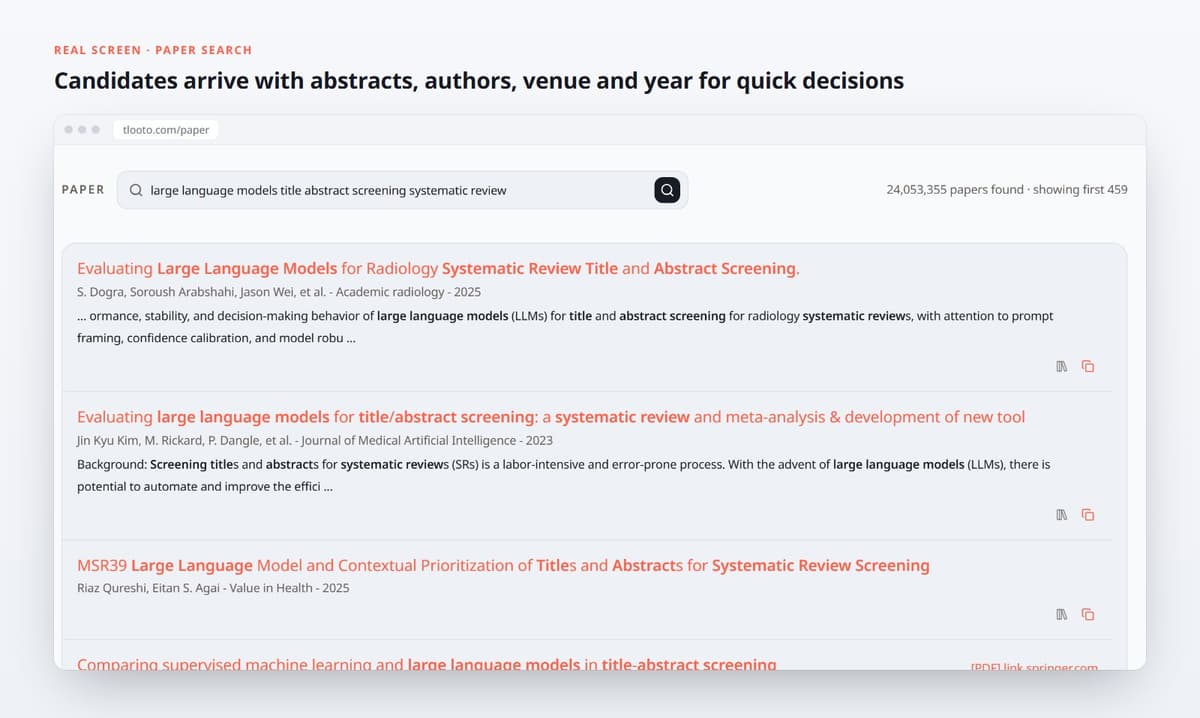
Machine learning has been used to accelerate screening in evidence synthesis for years [1]. The important part is not speed, it is auditability. A first pass is only useful if you can see why each paper was kept or excluded and check the borderline ones yourself.
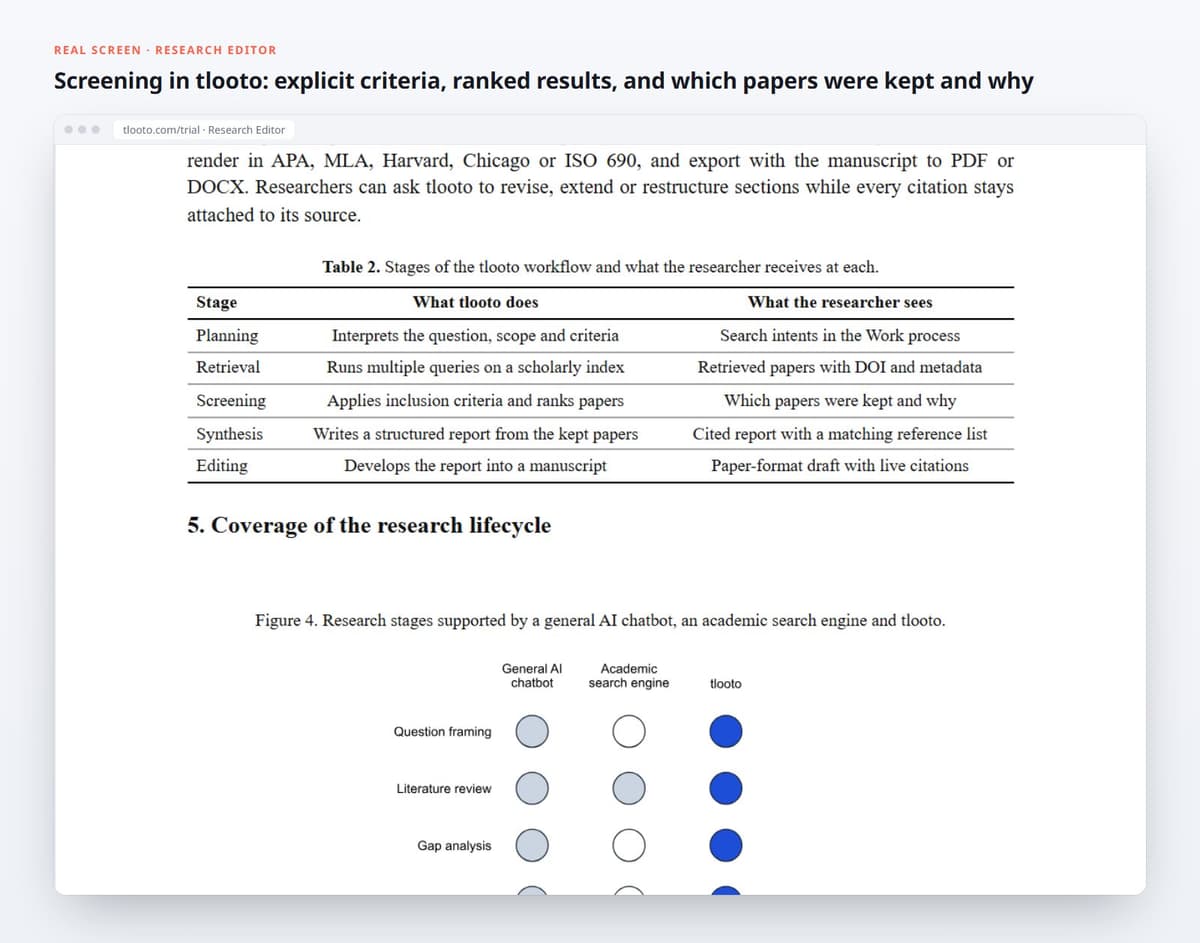
In tlooto, every candidate is assessed against explicit inclusion criteria drawn from your question, mirroring the screening stage of a systematic review. The papers that pass are ranked and passed to synthesis as a focused evidence set, and the Work process panel shows what was kept and why.
For a formal systematic review, treat this as a second reviewer or a prioritization step, not a replacement for your protocol. Keep dual screening where your methods require it, and report AI assistance transparently in line with PRISMA 2020.
A weekend-saving checklist
- Criteria written and piloted on 20 abstracts.
- Three decisions: include, exclude, unsure.
- Blocks of 50, criteria re-read before each block.
- AI first pass with visible reasons; you audit the unsure and borderline.
- Every exclusion reason recorded for your flow diagram.
See screening in a tlooto report →
References
[1] Marshall, I. J., & Wallace, B. C. (2019). Toward systematic review automation: a practical guide to using machine learning tools in research synthesis. Systematic Reviews, 8. https://doi.org/10.1186/s13643-019-1074-9