


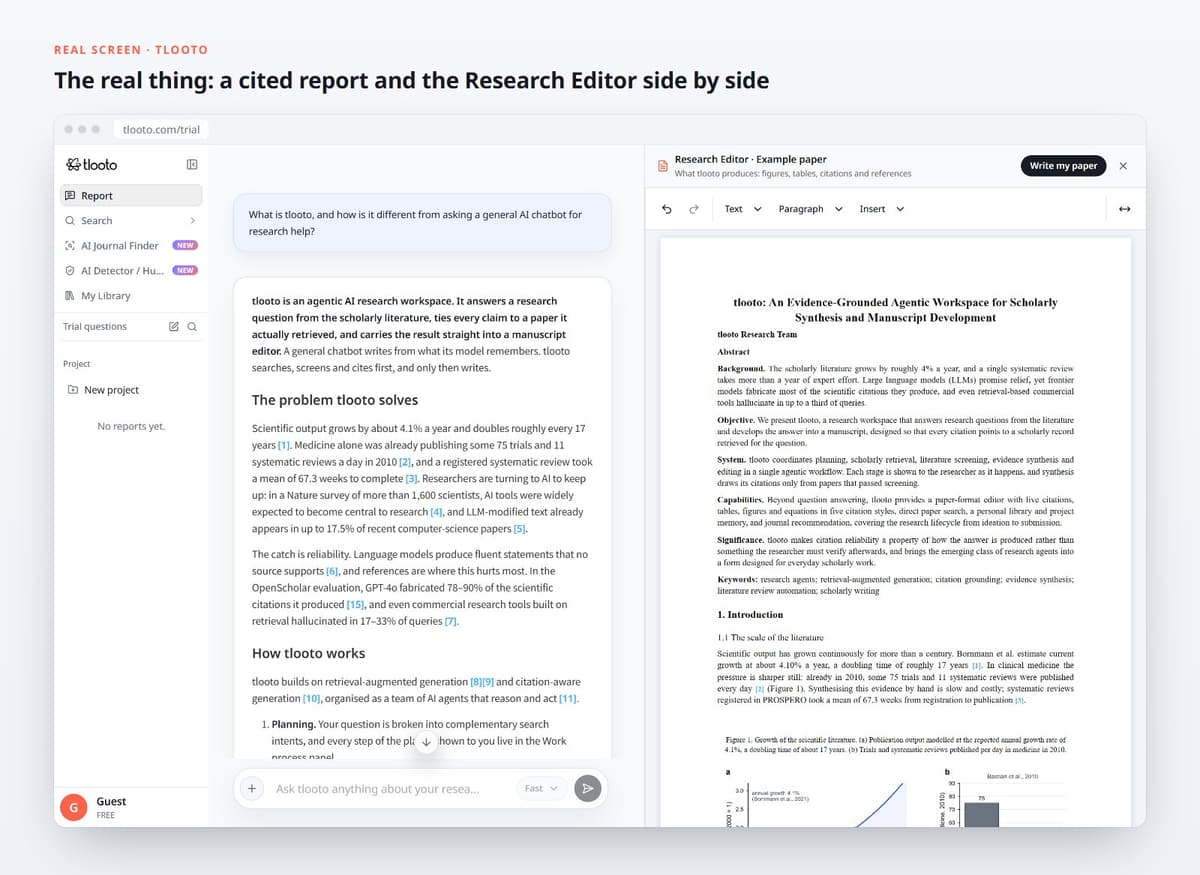
An illustrative walkthrough of the tlooto workflow, from a research question to a formatted manuscript.
Most research tools do one step well. A search engine finds papers. A chatbot writes fluent text. A reference manager formats citations. The trouble is the gaps between them, which is where researchers lose hours and where fabricated citations sneak in.
tlooto is built as one agentic workflow, so the evidence never leaves the process. Here is what happens in the animation above, stage by stage.
1. Plan
Your question is interpreted together with any scope, discipline and inclusion criteria you give it, and broken into complementary search intents. You see the plan as it forms.
2. Search
Several reformulated queries run for each intent against a scholarly index, and the results are merged. Every record carries its authors, venue, year, abstract and DOI.
3. Screen
Each candidate is checked against explicit inclusion criteria, the same logic as the screening stage of a systematic review. Papers that pass are ranked into a focused evidence set rather than a raw list of hits.
4. Synthesize
The report is written from the screened papers only. Every statement carries a numbered citation, and the reference list is generated from the same records, so the body and the bibliography always agree. A reference that is not in the retrieved evidence has nowhere to come from. That is the moment in the animation where the fabricated citation is struck out.
5. Write
One click opens the report in the Research Editor as a paper-format draft with live citations, tables, figures and equations, in APA, MLA, Harvard, Chicago or ISO 690, ready to export to PDF or DOCX.
What you see at every step
The Work process panel streams every plan, query, screening decision and intermediate result while it happens. You can see what was searched, which papers were kept, and how the answer was assembled. That is a record you can follow, check and describe in your own methods section.
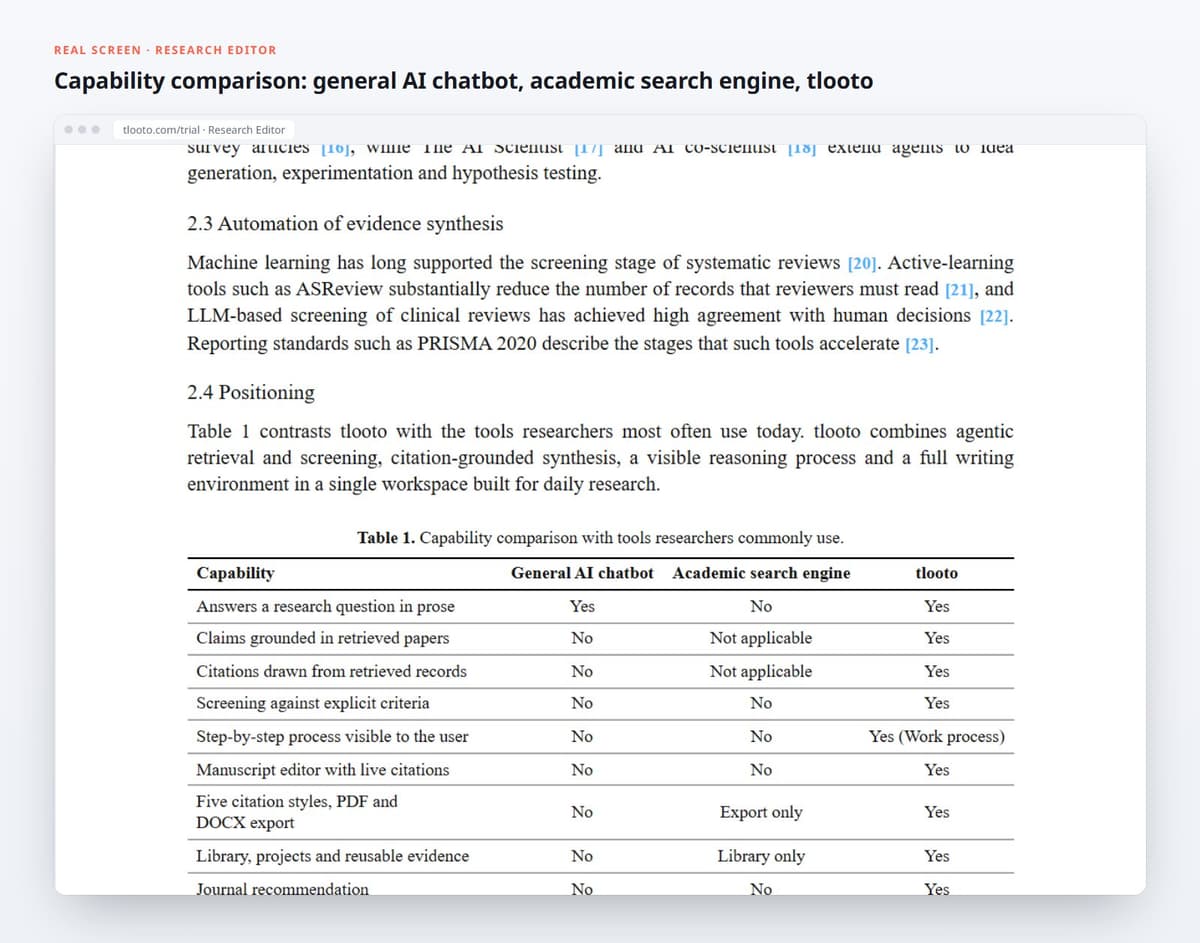
Around this core loop sit the tools researchers asked us for most: paper and journal search, AI Journal Finder for choosing where to submit, an AI Detector with sentence-level evidence, and a Library and Projects that keep your sources and context between sessions.