


Papers become rows, cells fill from the screened evidence, and every row keeps its citation. Illustrative.
After a few weeks of reading, most literature reviews exist as a folder of PDFs, a document of scattered notes and a vague memory of which paper said what. The moment you need to compare studies, that memory fails.
An evidence table fixes this. One row per study, the same columns for every row. It is the single most useful artifact in a review, and supervisors love it because it shows your reasoning.
The columns that matter
- Study. First author, year, and a citation you can click.
- Population and sample. Who, where, how many. This is what decides whether studies are comparable.
- Design and method. Cross-sectional, longitudinal, experimental; how the key variable was measured.
- Main finding. One sentence, with the effect size if there is one.
- Limitations. In the authors’ words where possible. This column is where research gaps come from.
Resist adding more columns until you need them. A narrow table you keep up to date beats a wide one you abandon.
Keeping it honest
The risk with any summary table is drift: a finding gets simplified, then simplified again, until the row says something the paper does not. Two habits prevent it. Quote the key number rather than paraphrasing it, and keep the citation in the row so anyone can check the source in one click.
Letting tlooto draft the first version
In tlooto, ask for the table directly: Build an evidence table of studies on smartphone use and GPA in undergraduates with columns for sample, design, main finding and limitations. The table is drafted from the papers that passed screening, and each row carries a numbered citation linked to its source.
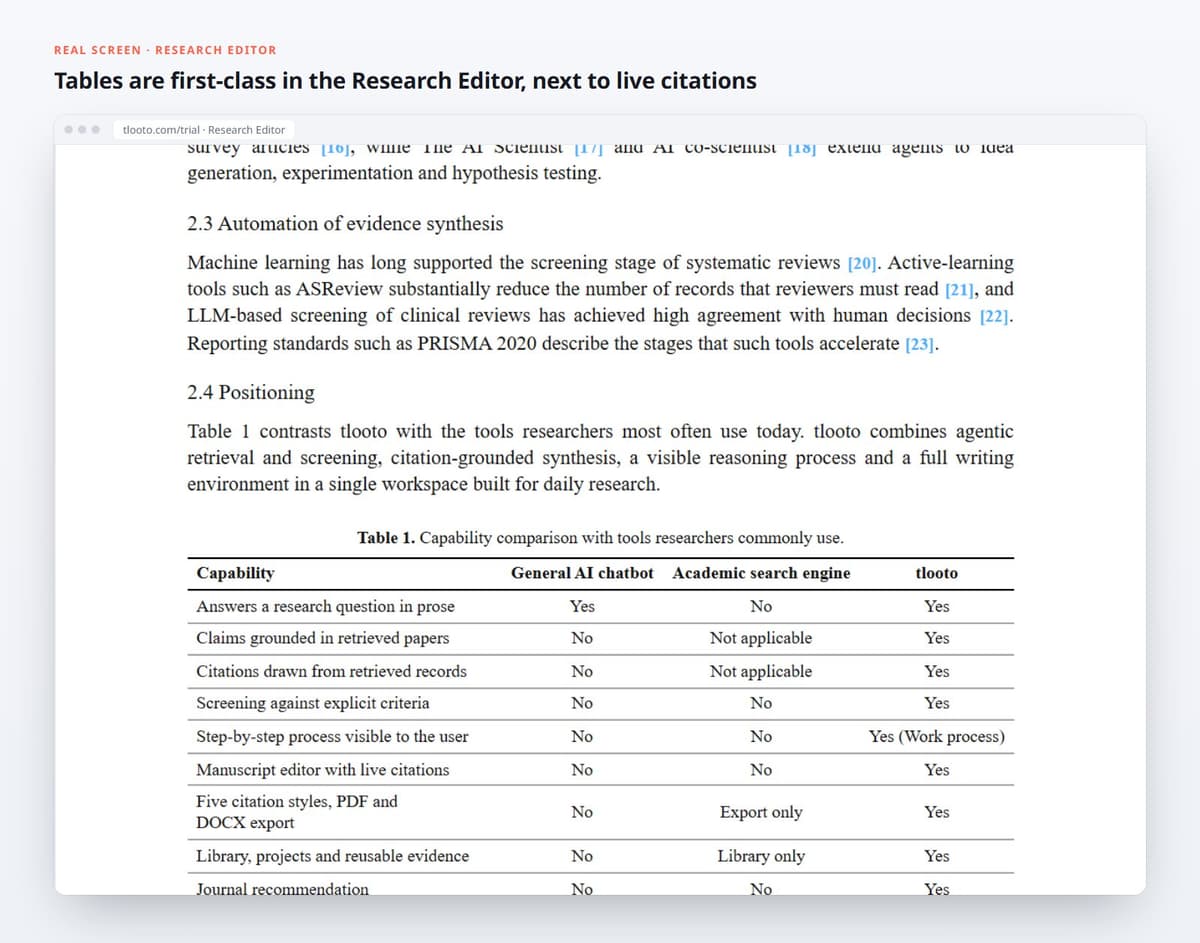
Open it in the Research Editor and it becomes part of your manuscript, with citations that renumber as you edit. Then do the part only you can do: check the rows against the papers that matter most, fix what is oversimplified, and decide what the pattern means.