Five sentences, one job each. Illustrative.
An editor reads your title, then your abstract, and in many cases decides there. Reviewers accept or decline an invitation based on the same paragraph. Most readers who find your paper later will never read more than this. It deserves more than the last hour before submission.
One sentence, one job
A structured approach works even when the journal asks for an unstructured abstract. Write five sentences, each with a single job, then expand where the word limit allows.
- Context (1 sentence). The problem and why it matters now. Not the history of the field.
- Gap (1 sentence). What is not known. This is the sentence that justifies the paper.
- Method (1 to 2 sentences). Design, sample, key measures. Enough that an expert can judge credibility.
- Result (1 to 2 sentences). The main finding with a number: an effect size, a difference, a confidence interval.
- Implication (1 sentence). What changes because of this result, stated no more strongly than the data allow.
Three edits that make it land
Put a number in the result sentence.Students using phones more than seven hours a day had a first-semester GPA 0.21 points lower is a finding. Smartphone use was associated with academic performance is a topic.
Cut the throat-clearing. Phrases like in recent years or it is widely recognized that cost words and say nothing. They also read as generic, which some AI detectors flag.
Match the vocabulary of the field. Use the terms the target journal’s readers search for. That is what gets your paper found after publication.
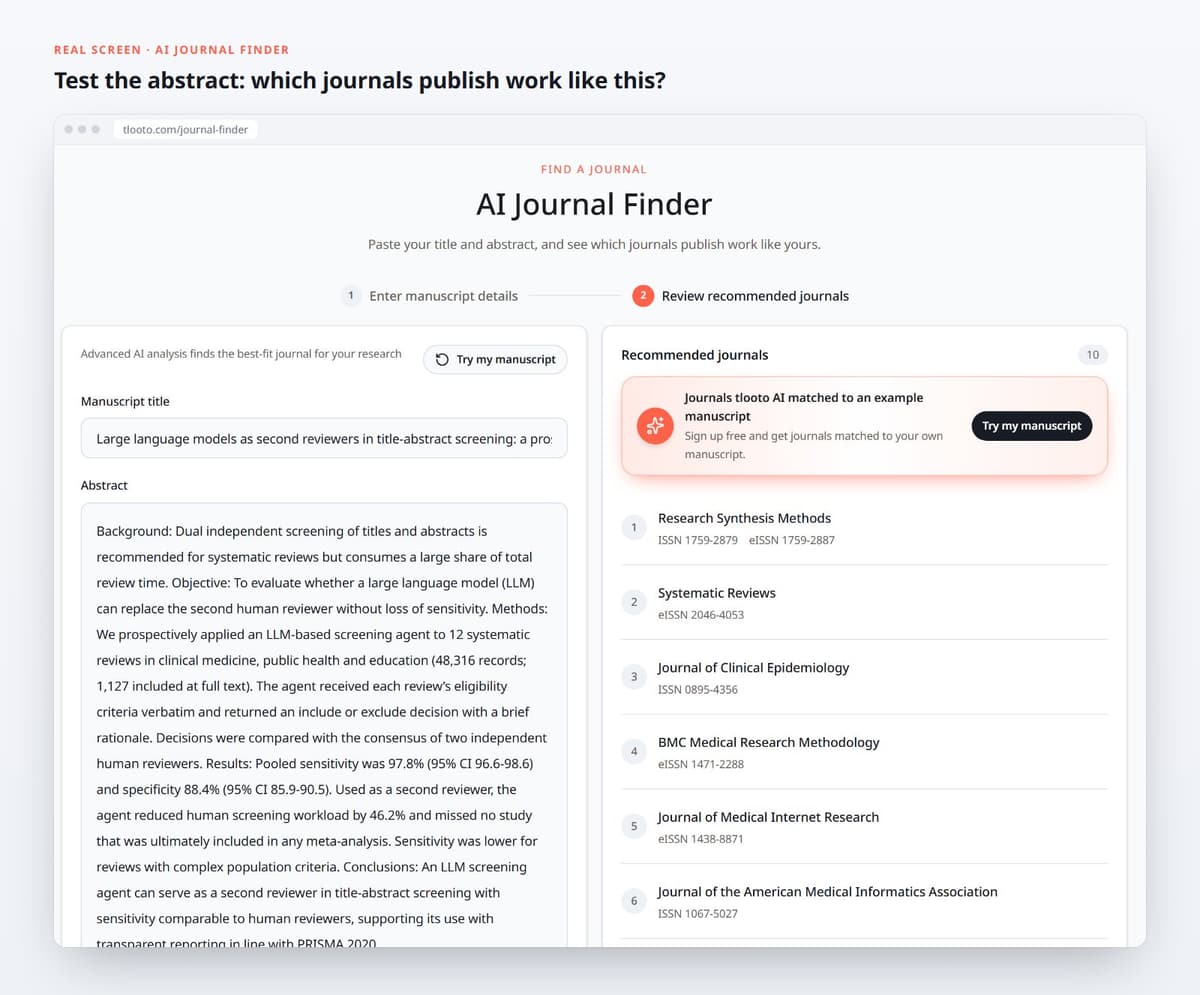
Test the abstract against journals
Paste your title and abstract into AI Journal Finder. It returns journals that publish work like yours. If the list surprises you, your abstract may be signaling a different field than you intend, and that is worth fixing before an editor reaches the same conclusion.