


A generic sentence becomes a specific one: an illustrative rewrite.
Most of the world’s researchers write papers in a second language. They know their field deeply and their data better than anyone, and then spend days on sentences that still feel stiff. Some are told by a detector that their own writing “looks AI-generated.”
That second problem is real. In a Stanford study, GPT detectors misclassified more than half of TOEFL essays written by non-native English speakers as AI-generated [1]. Careful second-language writing tends to use safe, common phrasing, and common phrasing is what detectors and bored reviewers both notice.
The fix is specificity, not fancier English
You do not need rarer words. You need sentences that could only have been written by someone who did your study. Compare:
These findings highlight the importance of adopting a holistic approach.
The gap in GPA shrank from 0.21 to 0.09 points once we adjusted for sleep, which suggests sleep explains part of the effect.
The second sentence is not more elaborate. It is more specific. It contains a number, a comparison and a claim sized to the evidence.
Five edits that keep your voice
- Replace summary adjectives with numbers.Significant, substantial, notable → the actual value.
- Name the subject.It was found that → We found, or Lemola et al. found.
- Delete stacked transitions.Furthermore, Moreover, Additionally at the start of consecutive sentences read as filler.
- One idea per sentence. Long sentences with three clauses are where grammar breaks and meaning blurs.
- Keep your terms stable. Pick one word for each concept and use it every time; varying it for style confuses readers.
Where tlooto helps, and where it should not
tlooto’s AI Detector shows which sentences look generic and why, sentence by sentence. The pattern is usually clear: the findings pass, the transitions and summaries get flagged. The Humanizer can suggest a rewrite for a flagged sentence, and you decide what to keep.
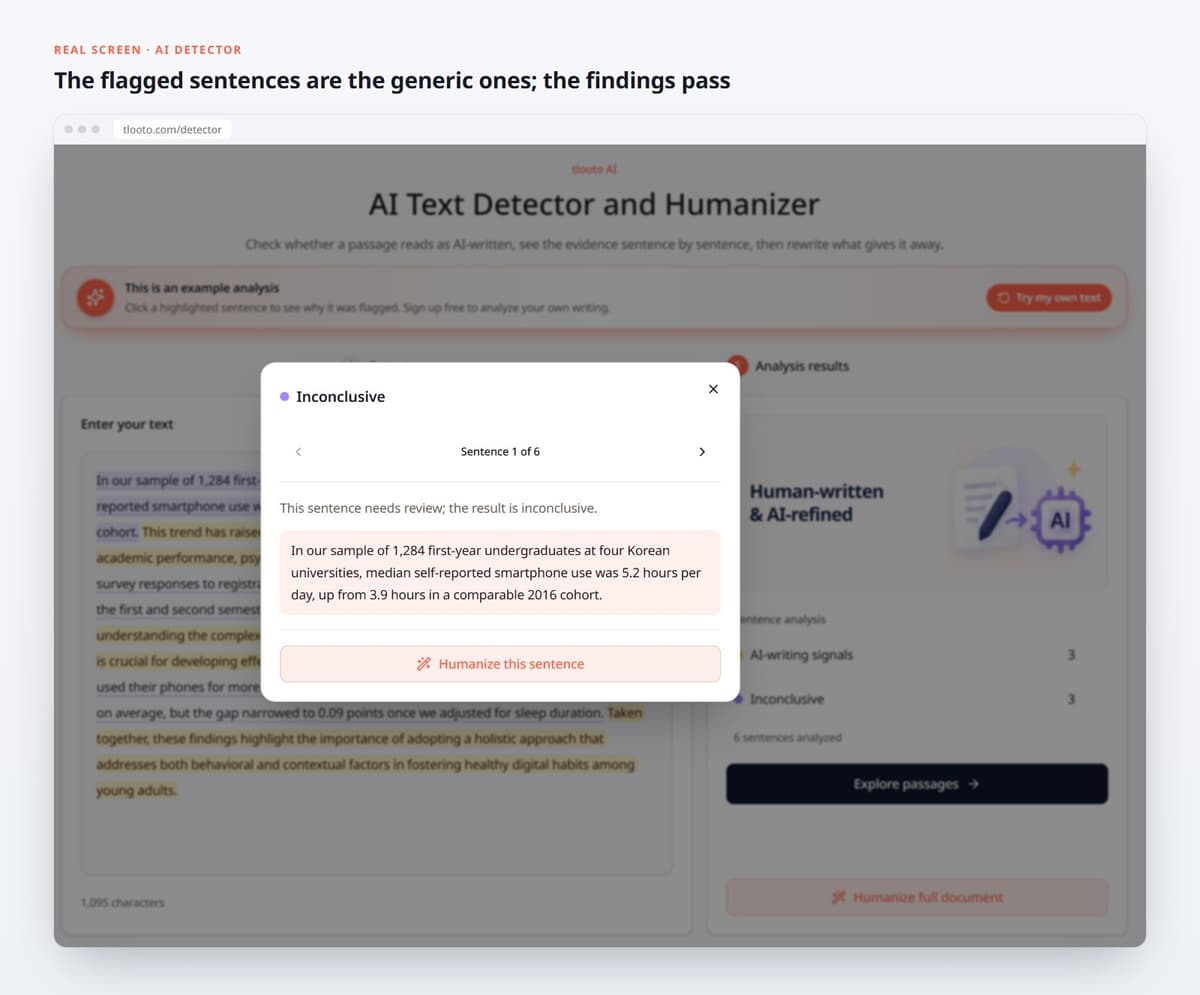
Use these tools to find weak sentences, not to disguise authorship. Follow your institution’s policy on AI assistance and disclose it where required. The goal is writing that is clearly yours and clearly understood.
References
[1] Liang, W., Yuksekgonul, M., Mao, Y., Wu, E., & Zou, J. (2023). GPT detectors are biased against non-native English writers. Patterns, 4(7). https://doi.org/10.1016/j.patter.2023.100779