


Six checks, two kinds of tools. Illustrative.
In a Nature survey of more than 1,600 researchers, many expected AI tools to become important or essential to their work [1]. The question is no longer whether to use AI in research, but which tool you can defend using when a supervisor, reviewer or examiner asks how a claim was produced.
These six questions work for any tool, including ours.
1. Where do the claims come from?
From the model’s memory, or from papers retrieved for your question? Only the second can be checked.
2. Can I open every citation?
Every reference should resolve to a real paper, ideally with a DOI. In one study, 55% of GPT-3.5 citations and 18% of GPT-4 citations were fabricated [2]. If you cannot open it, do not cite it.
3. Can I see how the answer was built?
Which searches were run, which papers were kept and why? A process you can see is a process you can describe in your methods section.
4. Does it apply criteria, or just rank by relevance?
Screening against explicit inclusion criteria is what separates evidence from search results.
5. Does it keep the evidence attached when I write?
If citations break the moment you move text into a document, errors will follow. Look for live citations in the drafting environment and standard citation styles.
6. Does a follow-up build on what was found?
Real research questions come in chains. A tool that starts from scratch every time wastes your evidence and your time.
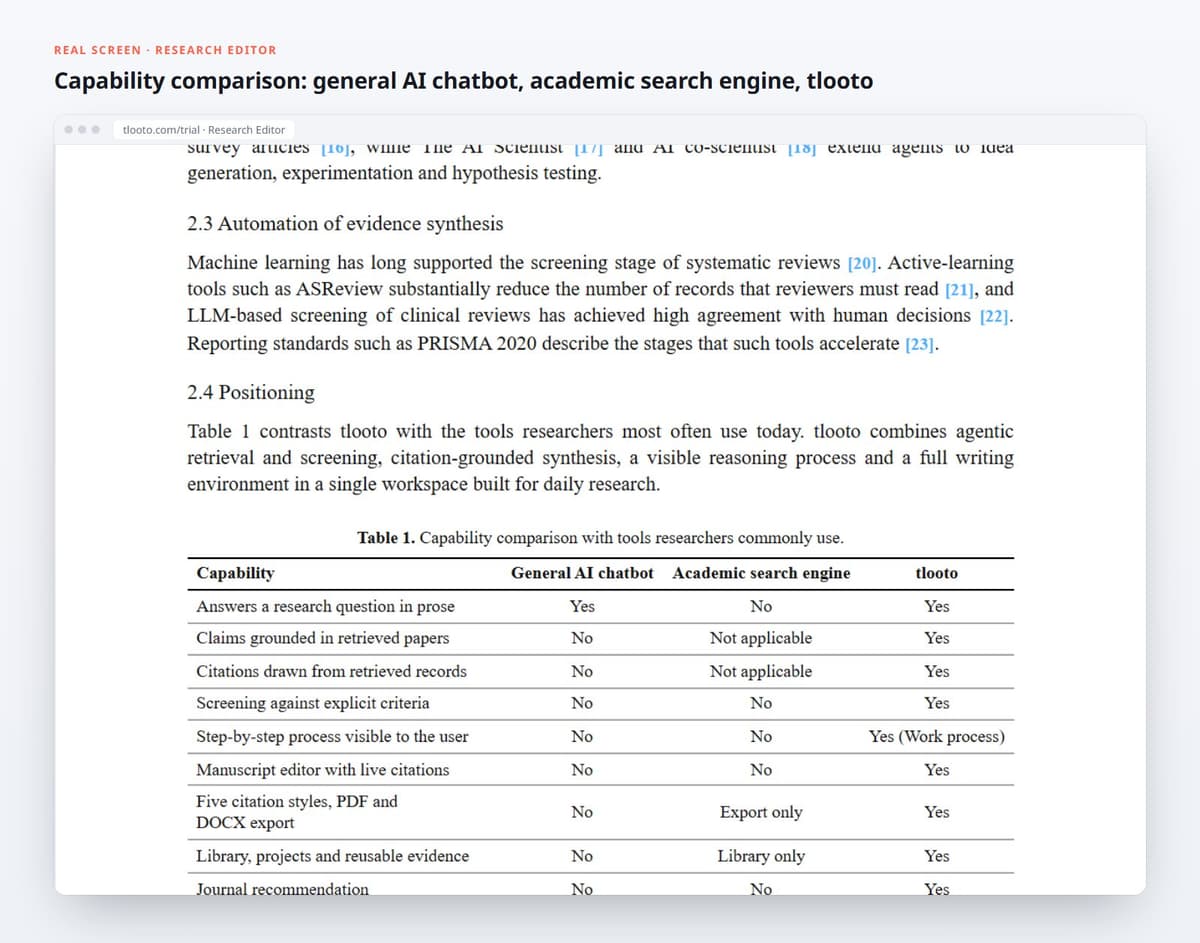
tlooto was designed around these six questions: retrieved papers with DOIs, screening against your criteria, a visible Work process, live citations in the Research Editor, and follow-ups that build on the evidence already gathered. Hold it, and every other tool you consider, to the same standard.
Run the six checks on tlooto yourself →
References
[1] Van Noorden, R., & Perkel, J. M. (2023). AI and science: what 1,600 researchers think. Nature, 621. https://doi.org/10.1038/d41586-023-02980-0
[2] Walters, W. H., & Wilder, E. I. (2023). Fabrication and errors in the bibliographic citations generated by ChatGPT. Scientific Reports, 13. https://doi.org/10.1038/s41598-023-41032-5