

1. What Are Impact Factor Journals?
Impact factor journals are scholarly publications ranked by their Impact Factor (IF) — a measure of how frequently articles from a journal are cited in a particular period. The IF is typically calculated over a two-year window:
Formula:
IF = Citations in year X to articles published in years (X–1) and (X–2) / Total number of articles published in those two years.
For example, if Journal A received 500 citations in 2023 for articles published in 2021 and 2022, and it published 100 articles in those years, its 2023 IF would be 5.0.
2. Why Are Impact Factor Journals Important?
Publishing in impact factor journals can significantly enhance your academic profile:
▪️Academic Evaluation:
Most universities and funding agencies consider the IF of the journals where your work is published when evaluating research performance.
▪️Credibility & Peer Review Quality:
High IF journals usually have rigorous editorial standards, indicating trustworthiness and scientific merit.
▪️Global Reach:
Articles in impact factor journals are more likely to be discovered, read, and cited internationally.
3. Where to Find Impact Factor Journals
Here are reliable databases and tools to identify them:
▪️Journal Citation Reports (JCR)
Hosted by Clarivate Analytics, this is the gold standard for IF data.
▪️Scimago Journal Rank (SJR)
Powered by Scopus data and useful for checking H-index, quartile, and SJR score.
▪️Google Scholar Metrics
Offers insight into top journals based on citation data.
4. What to Watch Out for When Choosing a Journal
▪️Don’t Just Chase High IF:
A journal with a high IF might not align with your specific research scope. Always check aims and scope before submitting.
▪️Avoid Predatory Journals:
These exploit authors by charging high fees without proper peer review.
To verify a journal’s legitimacy:
- Check its inclusion in JCR, Scopus, or DOAJ
- Review editorial board credentials
- Look for transparent peer-review policies
▪️Language and Region Strategy:
While international impact factor journals offer broader reach, publishing in national journals (e.g., Korea Citation Index) may still be strategic depending on institutional goals.
5. How to Prepare for Submission to Impact Factor Journals
▪️Choose Target Journals Early:
Identify 3–5 potential journals before writing your manuscript. Look at where related papers are published.
▪️Follow Author Guidelines Exactly:
Each journal has specific formatting, reference styles (APA, MLA, IEEE), and length restrictions.
▪️Polish Your Manuscript:
Use AI-based proofreading tools or professional services to improve clarity and grammar.
👉 Looking for AI tools to assist with academic writing? Try tlooto for free.
6. AI-Powered Journal Recommendations
Modern tools can now analyze your abstract or full paper to recommend suitable impact factor journals.
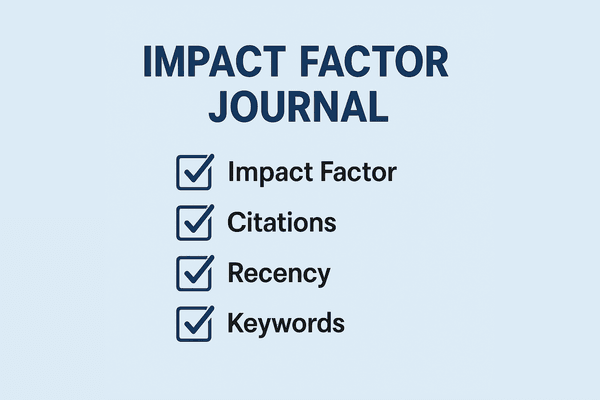
One such tool is tlooto, which uses over 200 million academic records to match your research with the most relevant and credible journals, tlooto uses a Weighted Evaluation System that includes Impact Factor consideration, citation count analysis, recency and relevance filtering, and precise keyword matching to ensure the best possible alignment.
7. Final Thoughts: Publish Where It Matters
Publishing in impact factor journals isn’t just about prestige — it’s about making your research visible, credible, and impactful. With the right tools and approach, you can boost your chances of being published in high-quality journals that matter to your field.
Read the Previous Article
-> "How AI for Researchers Is Transforming Modern Academia"
#impactfactorjournals #academicpublishing #researchstrategy #peerreview #journalimpact #openaccess #researchvisibility #tlooto #academicwriting #scholarlyjournals