

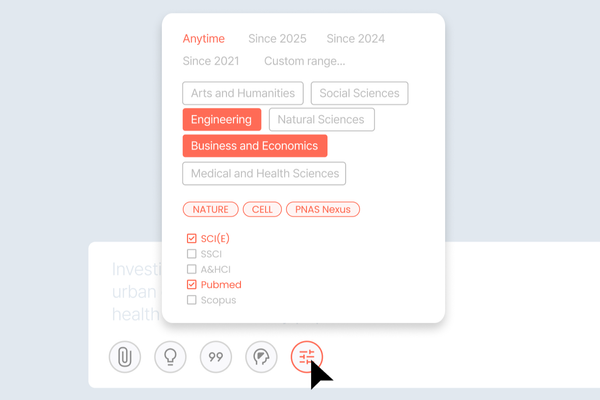
If you want to narrow the scope of your results, focus on a specific academic field, or change how the answer is presented, tlooto’s Fine-Tune feature helps you customize your query before submitting it. Click the icon above to open Fine-Tune settings.
When to use Fine-Tune
▪️You want to limit your search to recent or time-specific publications
▪️You want sources from certain disciplines only
▪️You’re preparing a report and need a cleaner, more structured format
What you can customize
1. Publication Year
Use this setting when you want to focus on studies published recently, or within a specific time frame that's relevant to your research topic. Set a time frame to prioritize recent research. Filtering by publication year is especially useful if you want to exclude outdated sources and highlight newer findings that reflect the current state of research. You can choose preset options like “Since 2021” to capture recent developments, or set a custom range (e.g., 2018–2022) for more control over the publication window.
2. Research Fields
Help tlooto understand which academic disciplines your question relates to. This improves both the relevance and the accuracy of the answer, especially for research-based queries. You can select one or more fields depending on your topic. If you're not sure, it's okay to leave it broad — but narrowing it down usually leads to better results.
You can select one or more of the following fields:
▪️Arts and Humanities
▪️Social Sciences
▪️Business and Economics
▪️Engineering
▪️Natural Sciences
▪️Medical and Health Sciences
Examples:
▪️AI in healthcare? → Select Engineering + Medical and Health Sciences
▪️Workplace stress and job satisfaction? → Select Social Sciences + Business and Economics
▪️Cultural impact of digital technology? → Try Arts and Humanities + Engineering
3. Journal Search
Use this setting when you want to explore academic journals relevant to your research topic. You don’t need to remember the exact journal titles — entering a short keyword is enough for tlooto to surface the most relevant options.
You can select one or several journals depending on your needs, and narrowing your choices often leads to more focused results.
Examples:
▪️Working on environmental science? → Select journals like Nature, Science, or Environmental Research Letters
▪️Researching psychology or human behavior? → Select journals such as Psychological Science, Journal of Applied Psychology, or Personality and Social Psychology Review
▪️Focusing on engineering or technology? → Select journals like IEEE Transactions, Advanced Engineering Materials, or Chemical Engineering Journal
4. Index Filter
An index refers to a standard used to evaluate the quality and credibility of academic journals.
In tlooto, researchers can select from the major indexes below to quickly filter and view only the journals that meet their field and research goals:
▪️SCI(E) – Leading journals in the natural sciences and engineering
▪️SSCI – Major journals in the social sciences
▪️A&HCI – Core journals in the arts and humanities
▪️PubMed – A primary database for medical and life sciences literature
▪️Scopus – A comprehensive international index covering all academic disciplines
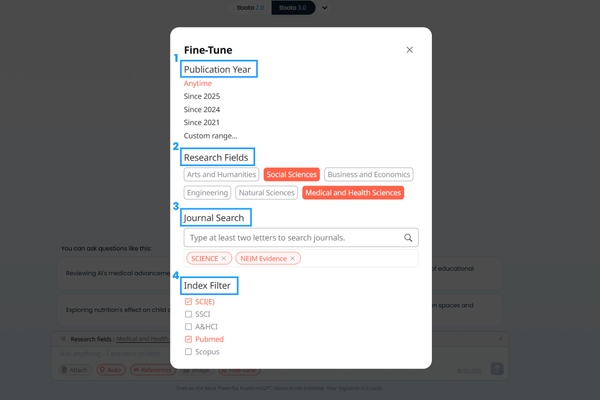
Once you set your preferences, tlooto will keep them active until you change them. It makes each answer more aligned with what you actually need.
Read Another Article
-> tlooto Model 1.0 vs. 2.0: Key Differences
#tlooto #tlootoAI #FineTune #AIresearch #AcademicAI #ResearchTools #AIforAcademia #AcademicWriting #LiteratureReview #AIsearch #ResearchAssistant